
Insights · Hospitality Marketing · 7 min read
Why Your Hotel's Best-Performing Creative Asset Is a Human Face
A 2024 study of 27,000+ Instagram posts found that hospitality content featuring people generates 49% more engagement than content without them. The implications extend far beyond social media, to OTAs, websites, performance marketing, and every visual touchpoint in the guest journey.
Brian Hughes. February 19, 2026
Your hotel's Instagram just posted a gorgeous wide-angle of the infinity pool at sunset. The lighting is perfect. The colors are rich. The composition is flawless.
It underperforms a slightly blurry photo of a couple laughing in that same pool by 49%.
This isn't a hunch. A 2024 study published in the Journal of Destination Marketing & Management analyzed over 27,000 Instagram posts using AI-powered image classification and found a consistent, statistically significant pattern: hospitality content featuring people dramatically outperforms content without them. And the implications extend far beyond social media.
The Research: 27,000 Posts Don't Lie
Researchers from the Universities of Leon, Salamanca, and Zaragoza built one of the largest visual content studies in tourism marketing history. They scraped 139,273 Instagram posts from a UNESCO World Heritage destination, filtered them down to 27,088 positive-sentiment posts from real tourists and residents, and then used deep learning neural networks to classify every image by scene type (hospitality service vs. place of interest) and whether people appeared in the photo.
The results were unambiguous:
Photos with people generated 49% higher engagement than photos without (9.41 vs. 6.31 average engagement rate). This held true whether the image showed a landmark, a restaurant, a hotel lobby, or a beach.
The effect was even more dramatic for tourist-generated content. When a tourist shared a photo that included people, engagement jumped to 11.58, compared to 6.77 for tourist photos without people. That's a 71% lift from a single variable: the presence of a human being in the frame.
Destination photos outperformed hospitality service photos by 2x (8.99 vs. 4.34). But here's what matters for hotel marketers: hospitality service photos with people significantly closed that gap, reaching engagement levels that photos of empty restaurants and lobbies never approached.
Why People Make the Difference
The researchers grounded their findings in mental imagery theory: the idea that when we see a person experiencing something in a photo, our brains automatically simulate that experience. We don't just see a pool. We feel the water. We imagine the sun on our shoulders. We project ourselves into the scene.
An empty suite, no matter how beautifully photographed, is a product shot. A person unwinding in that suite is a story. And stories are what the human brain is wired to engage with.
This explains why the "people effect" was strongest for tourist content specifically. When a traveler posts a photo of themselves enjoying a destination, their followers see someone like them having an experience they could have. The aspiration is immediate and personal. When a resident posts similar content, it reads as routine. Interesting, but not aspirational.
What This Means Beyond Instagram
The study focused on Instagram engagement, but the underlying principle, that human-centric imagery triggers mental simulation and emotional connection, applies everywhere a hospitality brand uses visual content to influence a decision.
OTA Listings
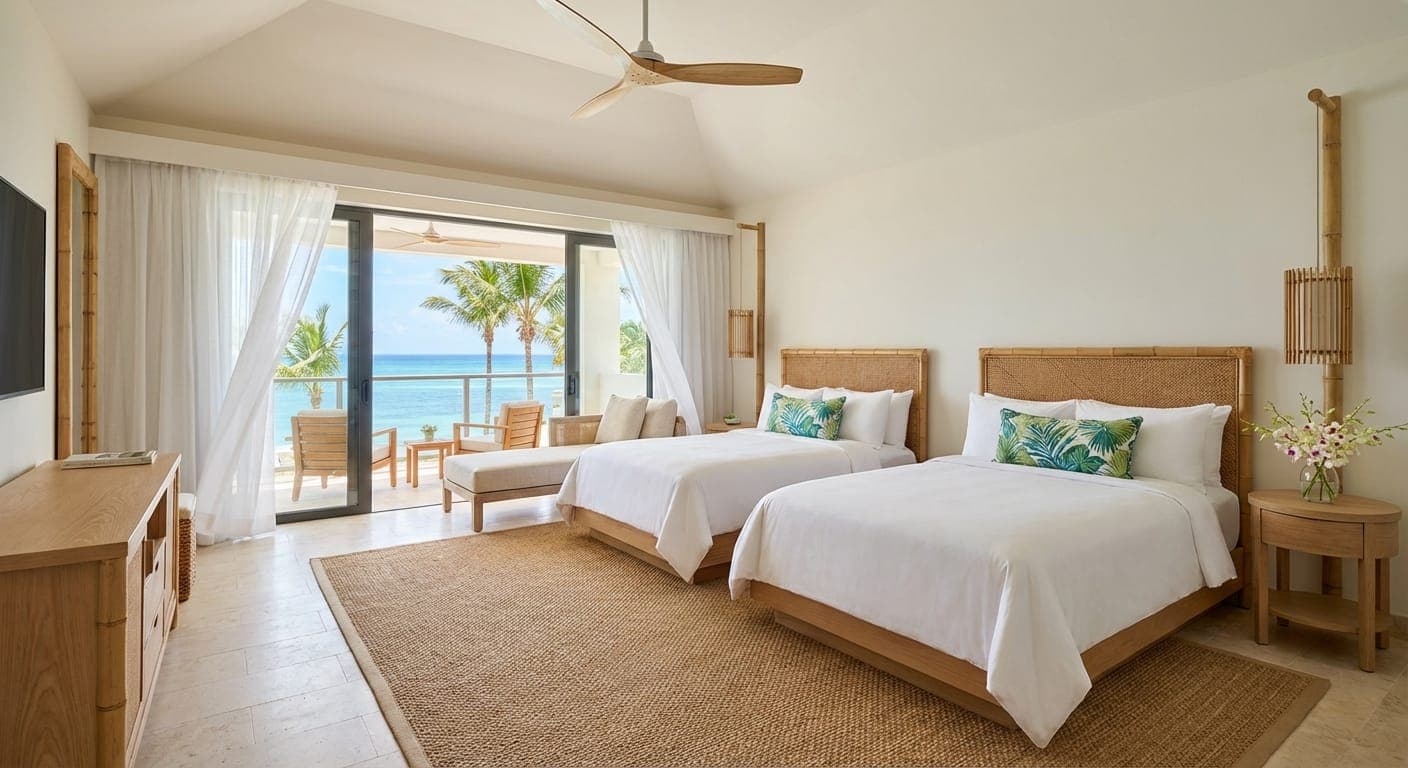
Your OTA gallery is often the first visual impression a potential guest encounters. Most hotels fill these slots with architecture: the exterior at dusk, the empty lobby, the perfectly made bed. These are table stakes. They confirm you're a real hotel. They don't create desire.
The properties that convert on OTAs are the ones where potential guests can see themselves in the photos. A couple at the rooftop bar. A family on the beach. A solo traveler reading by the pool. These images do the mental imagery work that an empty room photo physically cannot. They help the viewer imagine being there.
Your Website
The same principle applies to your direct booking funnel. Hero images, gallery pages, room detail shots, amenity sections. Every visual touchpoint is an opportunity to either show a space or show an experience.
Consider the difference between "King Suite with Ocean View" illustrated by an empty room versus illustrated by someone waking up to that view, coffee in hand, curtains pulled back. The room is the same. The emotional response is not. And in a booking decision that often comes down to gut feeling between two comparable properties, that emotional response is the tiebreaker.
Performance Marketing
This is where the research finding becomes directly measurable in your ad account. If human-centric content generates 49-71% more organic engagement on social media, the signal for paid creative is even stronger, because engagement rate is one of the core signals platforms use to determine ad quality and delivery cost.
Higher engagement creative gets rewarded with lower CPMs, higher delivery, and better placement. It compounds: the same budget reaches more people, generates more clicks, and produces more bookings. We've seen this pattern consistently across hospitality ad accounts. Creative featuring real human experiences outperforms property-only creative on CTR, cost-per-click, and downstream conversion metrics.
Social Media Content Strategy
The study's finding that tourist-generated content outperforms all other sender types points to a clear strategic direction: user-generated content (UGC) featuring guests should be a pillar of your social strategy, not an occasional repost.
This means designing moments worth photographing. It means creating spaces and experiences that guests naturally want to share. And it means having systems in place to identify, collect, and redeploy that content across your owned channels, with permission, of course.
The research also confirmed that influencer-level accounts (more followers than following) generate significantly higher engagement, which suggests a layered approach: UGC from real guests for authenticity and volume, plus strategic influencer partnerships for reach and production quality. Both should center on people having experiences, not just photographing spaces.
The Practical Shift
None of this means you stop shooting your property. Architectural and landscape photography still matters for establishing place identity, visual brand consistency, and conveying the physical product. The research showed that destination imagery (places of interest) drove strong engagement on its own.
But if your current content mix across channels is 80% empty spaces and 20% people, the data suggests you're leaving significant performance on the table. A more effective ratio might be the inverse: leading with human experience and supporting with space and place.
Here's what that looks like in practice:
Audit your visual assets. Look at your OTA galleries, website imagery, social content, and ad creative. What percentage features people? If it's under 50%, you have a clear opportunity.
Build a UGC pipeline. Make it easy and rewarding for guests to share their experience, and systematize how you collect and redeploy that content. A steady stream of authentic guest content is worth more than a quarterly professional shoot of empty rooms.
Brief your photographers differently. Whether it's an agency partner or an in-house team, the creative brief should prioritize capturing human moments in your spaces, not just the spaces themselves. The most effective hospitality photography puts a person in the frame and lets the property be the backdrop to their experience.
Test it in paid. Run a structured A/B test in your next campaign: same property, same offer, same targeting. One ad with people-centric creative, one without. Let your own data confirm what 27,000 Instagram posts already demonstrated.
The Bottom Line
The hospitality industry has long understood that it sells experiences, not rooms. But the visual marketing for most properties still leads with the room. The research is clear: when you put the experience, and the people having it, at the center of your visual strategy, engagement follows. Across social, OTAs, your website, and paid channels, the human element isn't a nice-to-have. It's a performance driver.
Your spaces are beautiful. Now show someone enjoying them.
Co-Founder at Vael Creative. Building AI-powered creative tools.